

You hit a big win, request a withdrawal, and then nothing happens. The payment sits on “pending” for days. Support sends the same copy-and-paste reply. Then you get an email saying your winnings have been voided because of a “bonus term violation” or “irregular play.”
A lot of Australian players end up in this spot. Some withdrawal problems come from normal verification delays. Others are deliberate stalling by operators who hope you’ll give up, or who will reverse your withdrawal and gamble it back. The good news is that you have more options than you might think, especially if you act quickly and keep good records.
This guide explains why online casinos withhold winnings, how Australian law affects your options, and what to do, step by step, to get paid.
Why Online Casinos Withhold Winnings
Before you escalate anything, work out which situation you’re in. The reason a casino gives for holding your money decides which strategy will work.
Legitimate Reasons for Delays
Not every delayed payout is a scam. Reputable operators have legal obligations under their licence, including anti-money laundering (AML) and know-your-customer (KYC) checks. These can slow down a withdrawal, particularly the first one or a large one.
Common legitimate causes include:
- Identity verification. The casino needs photo ID, proof of address, and sometimes proof that you own the payment method.
- Source of funds checks. Large wins or large deposits can trigger requests for bank statements or payslips.
- Pending period. Many casinos hold withdrawals for 24 to 72 hours before processing them.
- Payment method processing times. Bank transfers can take several business days, while e-wallets and crypto are usually faster.
- Weekend and public holiday delays. Finance teams often don’t process payments outside business hours.
Questionable or Unfair Reasons
This is where things get murkier. Some casinos use vague or hidden terms to avoid paying out, especially after a large win. Watch out for these explanations:
- “Bonus abuse.” Often applied loosely to players who did nothing more than play within the rules.
- Maximum bet rule breaches. Many bonuses cap your bet size (for example, $7.50 per spin) while wagering. Break it once, even by accident, and the casino may void everything.
- Restricted games. Playing a game excluded from bonus wagering can be used as grounds to confiscate winnings.
- Maximum win caps. Some bonuses cap cash-out at a multiple of the bonus, such as 10x.
- Duplicate account claims. Casinos sometimes accuse players of multiple accounts because they share an address or IP with a family member.
- Endless document requests. Asking for new documents again and again, or rejecting perfectly clear ones, is a common stalling tactic.
Quick Diagnostic Table
| Reason Given by Casino | Likely Legitimate? | What It Usually Means | Your Best First Move |
|---|---|---|---|
| “Account under verification” | Usually yes | Standard KYC check | Send clear, complete documents promptly |
| “Withdrawal pending” (under 72 hours) | Usually yes | Normal processing window | Wait, but note the time and date |
| “Withdrawal pending” (over 7 days) | Questionable | Possible stalling | Ask for a written timeframe |
| “Bonus terms violated” | Depends | Could be real or a pretext | Ask for the exact clause and bet history |
| “Irregular play” | Often questionable | Vague justification | Request specific evidence in writing |
| “Duplicate account” | Depends | Shared household or IP address | Provide proof of separate identities |
| “Account closed, winnings void” | Rarely fair | Confiscation | Escalate to regulator or ADR immediately |
| No response at all | No | Possible rogue operator | Document everything and escalate |
Understanding the Legal Situation in Australia
To understand your options, you need to know how online casinos are regulated in Australia, and where the gaps are.
The Interactive Gambling Act 2001
Under the Interactive Gambling Act 2001 (IGA), it is illegal to offer real-money online casino games, such as online pokies, roulette and blackjack, to people in Australia. Licensed Australian operators can only offer online sports betting and lottery products. The Act was strengthened in 2017 to crack down on offshore operators.
The law targets operators, not players. Australians who play at offshore casinos are generally not committing an offence. But because these casinos are not licensed in Australia, they aren’t bound by Australian consumer protections in the way a local bookmaker is.
ACMA’s Role
The Australian Communications and Media Authority (ACMA) enforces the IGA. It has asked internet service providers to block hundreds of illegal offshore gambling websites. You can report an illegal gambling service to ACMA, which helps with enforcement, but ACMA does not recover money for individual players.
What This Means for You
In practice, when an offshore casino refuses to pay, your leverage usually comes from:
- The licensing authority in the jurisdiction where the casino is licensed (if it has a licence at all).
- Alternative dispute resolution (ADR) services and independent complaint platforms.
- Your bank or payment provider, in some circumstances.
- Public reputation pressure, through reviews and complaint sites.
| Protection Type | Licensed Australian Bookmaker | Offshore Online Casino |
|---|---|---|
| Regulated under Australian law | Yes | No |
| Access to Australian state regulators | Yes | No |
| BetStop self-exclusion applies | Yes | No |
| Foreign licence regulator complaint | Not applicable | Yes, if licensed |
| ADR service available | Via state processes | Depends on licence |
| Australian courts practical | Yes | Rarely |
| Bank dispute options | Limited | Limited, case by case |
This is why choosing where you play matters so much, which we’ll come back to later.
Step-by-Step: What to Do When a Casino Won’t Pay
If your withdrawal has been delayed beyond a reasonable window, or your winnings have been voided, follow these steps in order. Each one builds your case for the next.
Step 1: Stay Calm and Don’t Reverse the Withdrawal
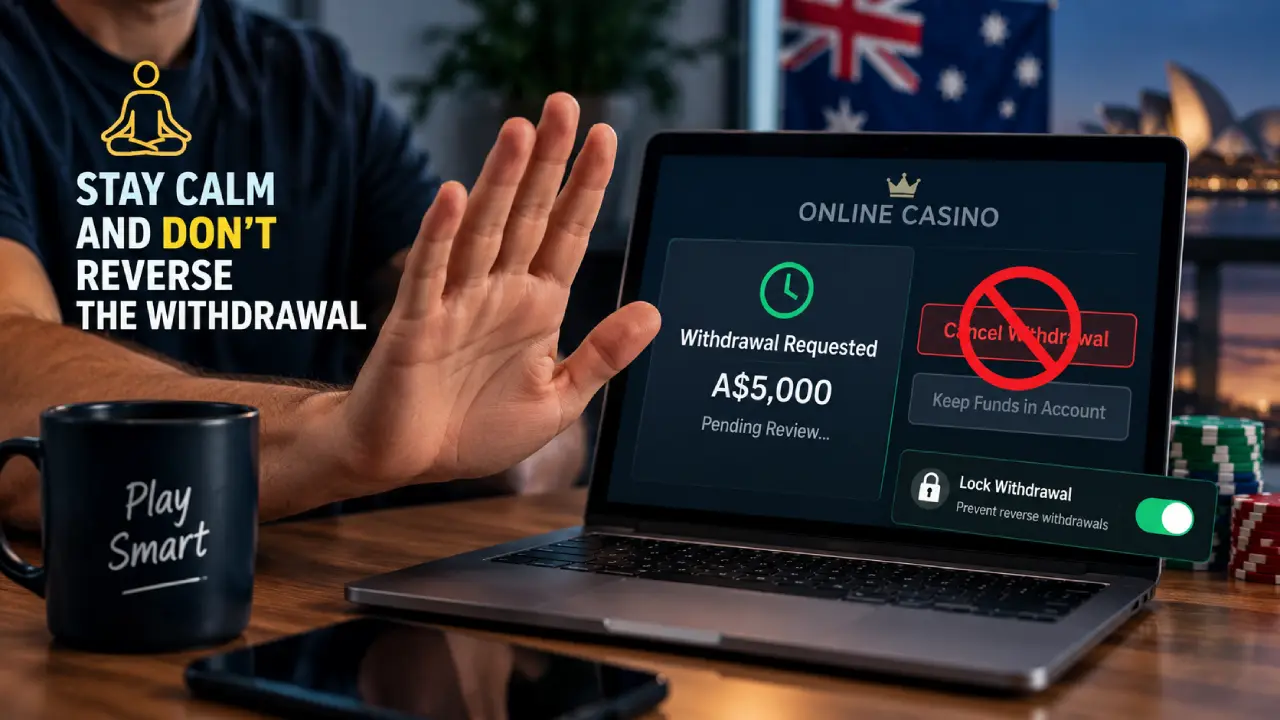
Many casinos let you cancel a pending withdrawal and send the money back to your playable balance. This “reverse withdrawal” feature is designed to tempt you. Don’t use it, and don’t keep playing with the funds. Once the money is back in play, getting it out becomes much harder, and further play can complicate any dispute.
If the casino offers an option to disable reverse withdrawals or “lock” your withdrawal, turn it on.
Step 2: Gather and Save All Evidence
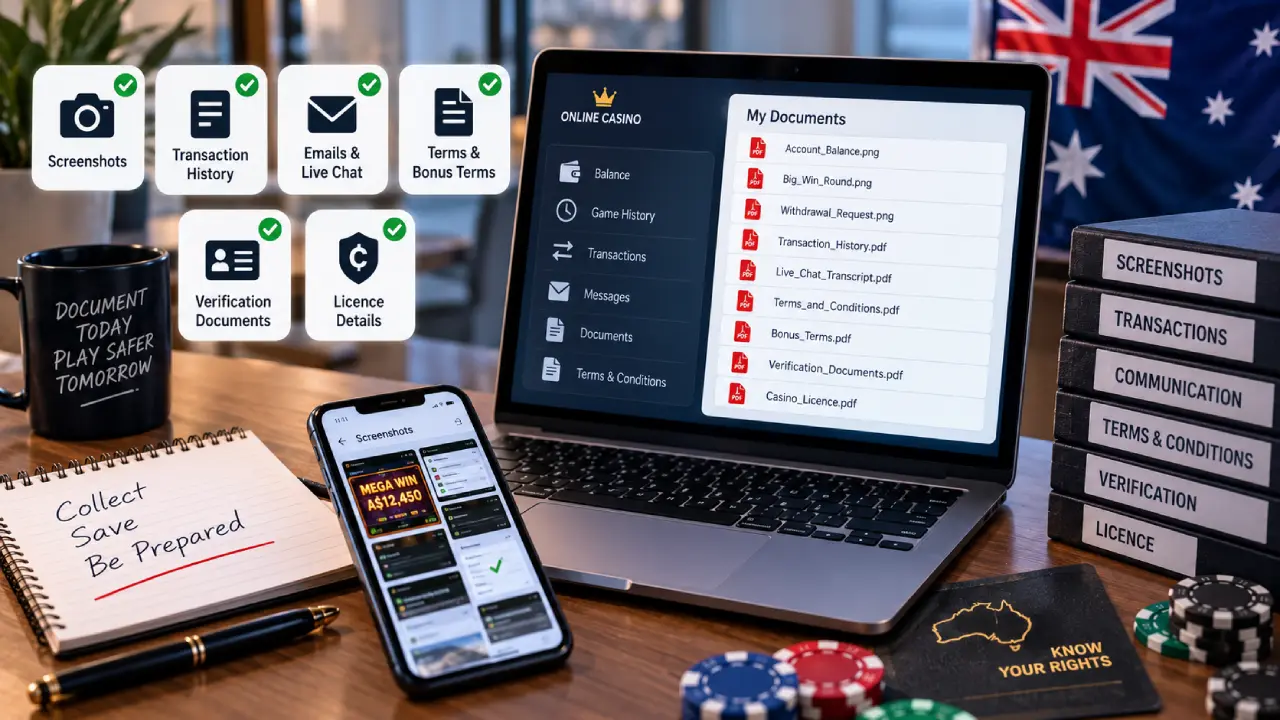
Your case lives or dies on documentation. Start collecting everything immediately, before the casino has a chance to change terms, close your account, or delete chat logs.
Save the following:
- Screenshots of your account balance, the winning game round and your withdrawal request.
- Your full transaction and bet history (download it if the casino allows).
- Copies of all emails and live chat transcripts.
- The casino’s terms and conditions and bonus terms as they were when you played. Save a PDF copy, since terms are sometimes updated after disputes begin.
- Proof of the documents you submitted for verification, with the dates you sent them.
- The casino’s licence details, usually found in the footer of the website.
Step 3: Complete Verification Properly
If the casino is asking for KYC documents, give them exactly what they ask for, in the format requested. Common requirements include:
| Document Type | Common Examples | Tips for Acceptance |
|---|---|---|
| Photo ID | Passport, Australian driver’s licence | All four corners visible, no glare |
| Proof of address | Utility bill, bank statement | Dated within the last 3 months |
| Payment method proof | Card photo (middle digits covered), e-wallet screenshot | Your name must be visible |
| Source of funds | Payslips, bank statements | Only needed for large amounts |
| Selfie verification | Holding ID next to your face | Good lighting, clear image |
Once you’ve sent everything, ask support in writing to confirm that your documents are complete and that no further items are needed. This closes off the “endless document request” tactic.
Step 4: Contact Support in Writing
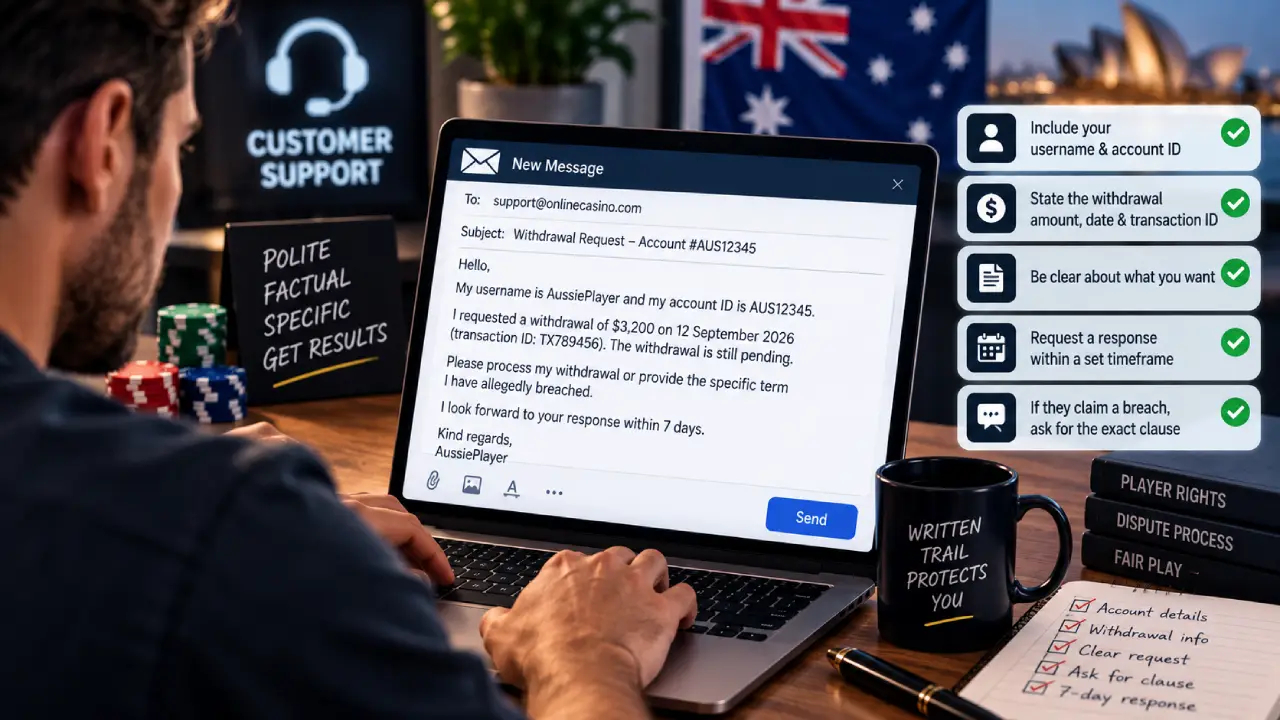
Live chat is fine for quick questions, but for a dispute you want a written trail. Send an email to the casino’s support or complaints address. Keep it polite, factual and specific. Include:
- Your username and account ID.
- The withdrawal amount, date and transaction ID.
- A clear statement of what you want (for example, “Please process my withdrawal of $3,200 or provide the specific term I have allegedly breached.”).
- A request for a response within a set timeframe, such as seven days.
If the casino claims a term breach, ask them to quote the exact clause and point to the specific bets or actions that broke it. Vague accusations often fall apart when a casino is asked for specifics.
Step 5: Use the Casino’s Formal Complaints Process
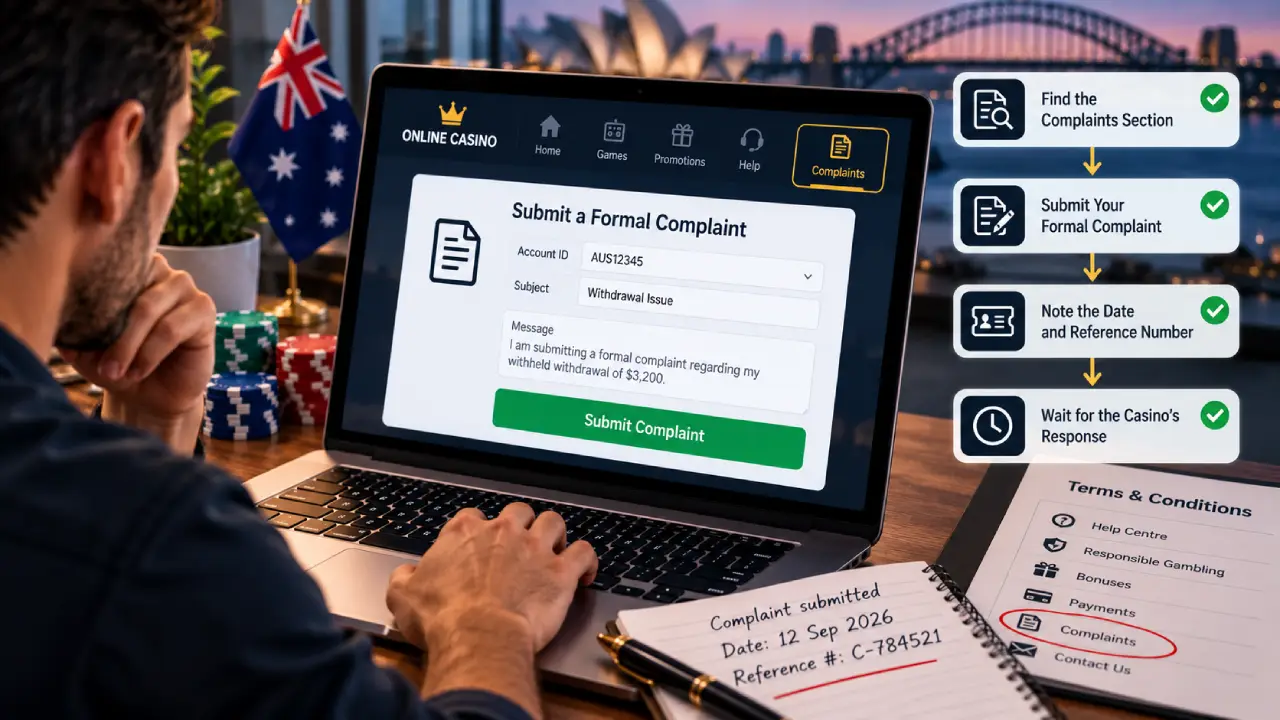
Licensed casinos are usually required to have an internal complaints procedure. Look for a “Complaints” section in the terms or help centre. Submitting a formal complaint matters because most regulators and ADR services won’t accept your case until you’ve gone through the casino’s own process first.
Note the date you lodged the complaint and any reference number you receive.
Step 6: Escalate to the Licensing Authority
If the casino doesn’t resolve your complaint, usually within a period of 2 to 8 weeks depending on the jurisdiction, take it to the regulator that issued the licence.
| Licensing Authority | Complaint Route | How Effective for Players? |
|---|---|---|
| Malta Gaming Authority (MGA) | Online player support form on the MGA website | Generally strong, with formal procedures |
| UK Gambling Commission | Via approved ADR providers | Strong, but UK-licensed sites rarely accept Australians |
| Curaçao Gaming Authority | Complaint channels under the updated licensing framework | Improving, but historically inconsistent |
| Kahnawake Gaming Commission | Written complaint to the commission | Moderate |
| Anjouan and other smaller licensors | Varies, often limited | Usually weak |
| No licence displayed | None | Very little recourse |
Always check the licence yourself. Legitimate licences can usually be verified by clicking the seal in the casino’s footer or searching the regulator’s public register. A fake or expired licence is a major red flag.
Step 7: Use Independent Complaint Platforms
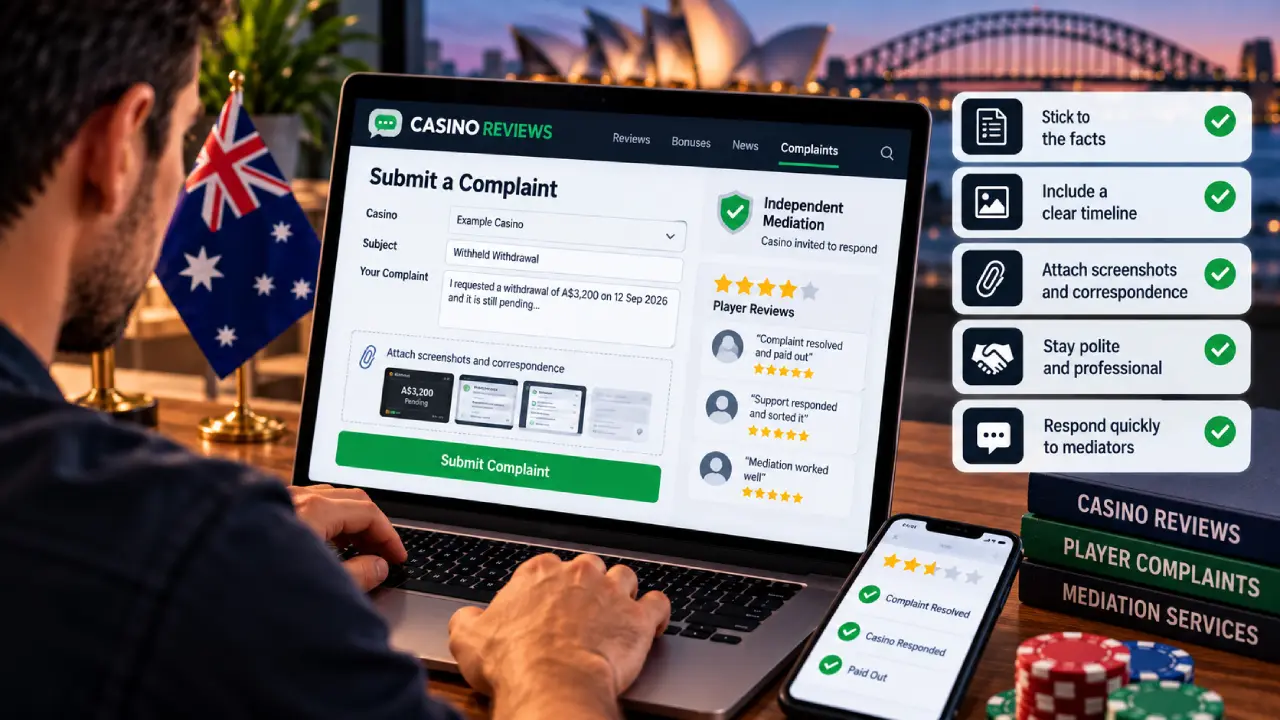
Independent casino review and complaint websites run mediation services where you can submit a public complaint. The casino is invited to respond, and many reputable operators take these seriously because unresolved complaints damage their ratings and traffic.
To make your complaint effective:
- Stick to the facts and include a clear timeline.
- Attach screenshots and correspondence.
- Stay polite, even if you’re frustrated.
- Respond quickly when mediators ask you questions.
These platforms have no legal power, but they do have reputational power, and plenty of players have been paid after a public complaint when direct contact went nowhere.
Step 8: Talk to Your Bank or Payment Provider
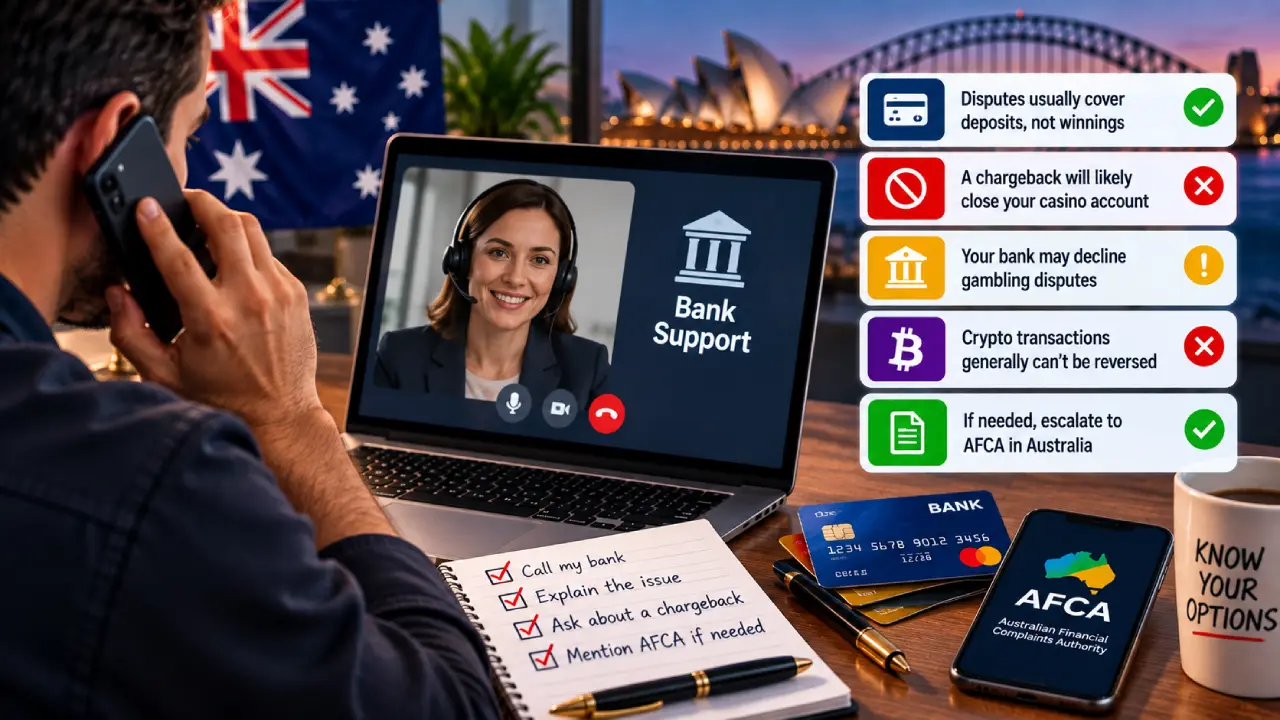
This option has limits, so it’s worth being realistic. A chargeback or dispute generally covers deposits you made, not winnings the casino owes you. If you’re disputing a deposit because a service wasn’t delivered as promised, or because you were defrauded, your bank may help. If your bank doesn’t handle a dispute fairly, you can escalate to the Australian Financial Complaints Authority (AFCA).
Keep in mind:
- A chargeback will almost certainly lead to your casino account being closed.
- It won’t recover winnings above your deposits.
- Banks may decline disputes relating to gambling transactions.
- Crypto transactions generally can’t be reversed at all.
Step 9: Report Scams and Illegal Operators

If the casino appears to be outright fraudulent, for example it has disappeared, has no valid licence, or is running rigged games, report it:
- Scamwatch (run by the ACCC) for scams targeting Australians.
- ReportCyber (via the Australian Cyber Security Centre) for online fraud.
- ACMA for illegal offshore gambling services.
Reporting may not get your money back directly, but it helps authorities block rogue sites and protects other players.
Step 10: Consider Legal Advice for Large Sums
If a significant amount of money is involved, a lawyer with experience in gambling or international consumer disputes can tell you whether legal action is realistic. For most players, cross-border legal action against an offshore operator is expensive and slow, so it’s usually a last resort.
Escalation Timeline at a Glance
| Stage | Action | Typical Timeframe |
|---|---|---|
| 1 | Wait for standard processing | 1 to 3 days |
| 2 | Complete KYC and confirm in writing | 1 to 7 days |
| 3 | Email support with a written request | Allow 7 days for a reply |
| 4 | Lodge a formal internal complaint | Allow 2 to 8 weeks |
| 5 | Escalate to the licensing authority | Several weeks to months |
| 6 | File on independent complaint platforms | Can run alongside stage 5 |
| 7 | Bank dispute or AFCA (deposits only) | Varies |
| 8 | Report to Scamwatch, ReportCyber or ACMA | Any time fraud is suspected |
How to Avoid Withheld Winnings in the First Place
The best dispute is the one you never have. A few habits before you deposit can save you a lot of stress.
Read the Bonus Terms Before You Accept
Most withdrawal disputes start with bonuses. Before you claim any offer, check:
- The wagering requirement (for example, 35x bonus plus deposit).
- The maximum bet allowed while wagering.
- Which games are excluded or contribute less.
- Whether there is a maximum cash-out limit.
- The time limit for completing wagering.
If the terms look confusing or overly strict, it’s often smarter to skip the bonus and play with your own cash. Winnings from real-money play without a bonus are much harder for a casino to dispute.
Verify Your Account Early
Complete KYC as soon as you sign up, not after you win. Upload your ID and proof of address straight away so that your first withdrawal isn’t held up by verification.
Choose Your Casino Carefully
This is the biggest factor of all. Well-run, properly licensed casinos with a track record of paying players are far less likely to invent reasons to keep your money. Before signing up, check the licence, read recent player reviews, look at complaint history, and compare withdrawal limits and processing times.
Doing that research yourself takes time, which is why many players start with a curated list of reviewed casino sites for Australian players. A good comparison resource lets you see licensing details, payout speeds, withdrawal limits, accepted payment methods and bonus conditions side by side, so you can spot warning signs before you deposit rather than after you’ve won. For players, that means fewer nasty surprises, clearer terms from the start, and a much lower chance of ending up in the kind of dispute this guide describes.
Red Flags vs Green Flags
| Red Flags | Green Flags |
|---|---|
| No licence or an unverifiable licence | Licence verifiable on the regulator’s register |
| Vague or constantly changing terms | Clear, stable and easy-to-find terms |
| Very low weekly or monthly withdrawal limits | Reasonable limits that match large jackpots |
| Many unresolved complaints online | Complaints are answered and resolved |
| Pressure to reverse withdrawals | Option to lock or flush withdrawals |
| Slow, scripted or non-existent support | Responsive support with real answers |
| Unrealistically large bonuses | Fair bonuses with transparent conditions |
| No responsible gambling tools | Deposit limits, time-outs and self-exclusion |
Pick Faster, Traceable Payment Methods
Your choice of payment method affects both speed and your ability to dispute a transaction later.
| Payment Method | Typical Withdrawal Speed | Dispute Options |
|---|---|---|
| Bank transfer | 3 to 7 business days | Limited |
| Debit card | 2 to 5 business days | Possible chargeback on deposits |
| E-wallets | Within 24 to 48 hours | Provider dispute process |
| Cryptocurrency | Minutes to a few hours | Almost none |
| Prepaid vouchers | Deposits only in most cases | Very limited |
Crypto is fast, but because transactions can’t be reversed, you’re relying entirely on the casino’s honesty. Use it only with operators you trust.
Common Mistakes Players Make During a Dispute
Even players with a strong case sometimes damage it without meaning to. Avoid these mistakes:
- Getting aggressive with support. Abusive messages can be used to justify closing your account.
- Opening a second account. This almost always breaks the terms and hands the casino a real reason to void your winnings.
- Waiting too long. Evidence disappears and some complaint processes have time limits.
- Relying on live chat only. Always follow up in writing by email.
- Doing a chargeback too early. It can close your account and end any chance of receiving your winnings.
- Ignoring document requests. Even if you think a request is unfair, answer it and keep a record.
Frequently Asked Questions
Is it illegal for Australians to play at offshore online casinos?
The Interactive Gambling Act 2001 makes it illegal for operators to offer online casino games to Australians. It generally doesn’t penalise individual players. However, because these casinos aren’t licensed in Australia, you have fewer local protections if something goes wrong.
How long should a casino withdrawal take?
It depends on the payment method and verification status. E-wallets and crypto can be paid within hours to two days, while bank transfers usually take three to seven business days. Anything beyond two weeks without a clear reason deserves escalation.
Can a casino legally keep my winnings?
A casino can void winnings if you genuinely broke its terms, such as exceeding a maximum bet during bonus wagering. It shouldn’t confiscate winnings based on vague claims or terms that weren’t clearly disclosed. Always ask for the specific clause and evidence.
Can I get my money back through my bank?
Sometimes, but usually only for deposits, not winnings. Banks handle gambling disputes case by case, and a chargeback will likely close your casino account. If your bank handles the dispute poorly, you can escalate to AFCA.
Does ACMA help players recover unpaid winnings?
No. ACMA enforces the Interactive Gambling Act and blocks illegal gambling websites, but it doesn’t resolve individual payment disputes. For those, you need to go through the casino’s licensing authority or an independent mediation service.
What’s the single best way to avoid withdrawal problems?
Choose a well-reviewed, properly licensed casino, verify your account early, and read bonus terms carefully before accepting any offer. Playing without a bonus removes most of the common excuses for withholding winnings.